Lola: Live Video Chat App
- 4.2
- Rating
- 1.00M
- Installs
- Free
- Price

 Analysis by App-foxy
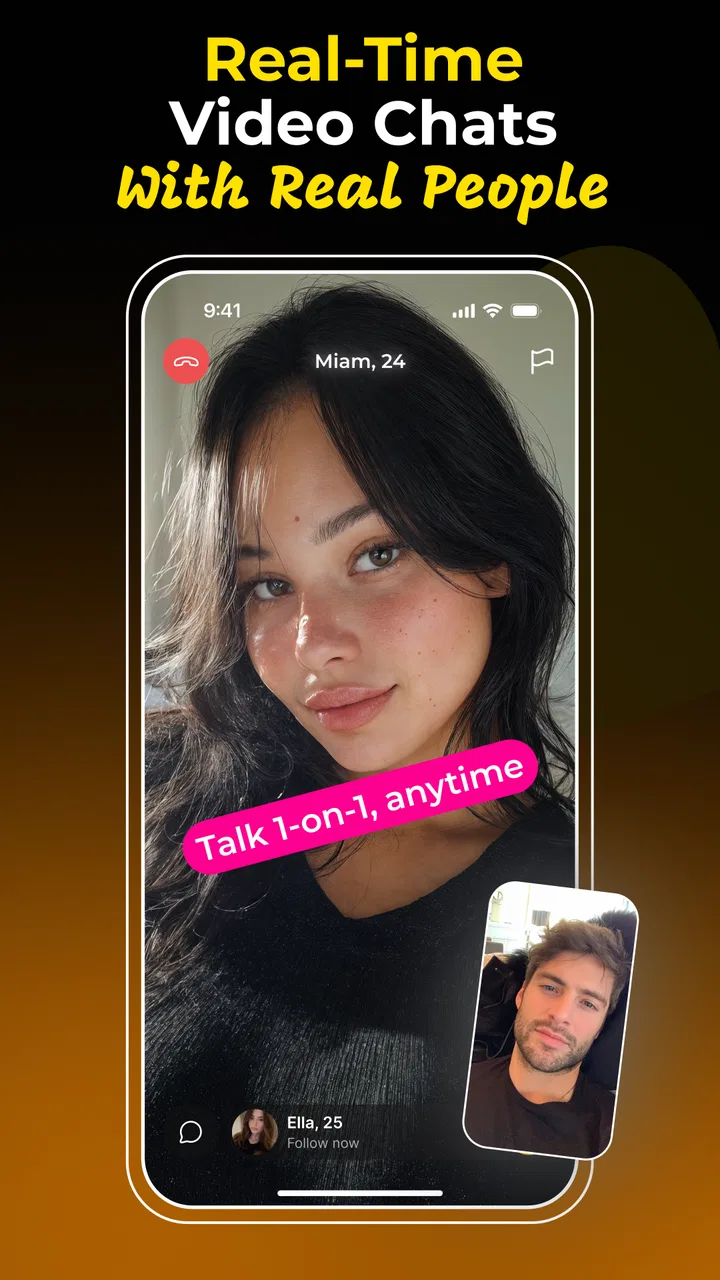
I tried Lola: Live Video Chat App as a social app built around direct, face-to-face conversations rather than a traditional feed. Its central idea is simple: connect with another person for a one-to-one live video chat, with instant translation intended to make conversations easier across language barriers. That focus gives it a very different feel from messaging apps, public social networks, and dating services that depend mainly on profiles and text.
My first impression was that Lola is designed for immediacy. You are not opening it to browse a long timeline or organize a group discussion. You are opening it because you want a live interaction with one other person. That makes the app potentially appealing when a short conversation feels more useful than another exchange of typed messages, but it also means the experience depends heavily on your comfort with spontaneous video and on the quality of the people you meet.
A social app built around one-to-one conversations
Lola is developed by Lola Team and sits in the social category. The current release is version 2.2.7, and it requires Android 8.0 or later. It is free to install, which makes trying the basic experience relatively easy. The app is rated Mature 17+, so I would not treat it as a casual platform for younger users or hand it to a child simply because the download itself costs nothing.
You May Also Like

 Blood Strike: 2.5 Anniversary
Blood Strike’s Loadouts Turn Every Drop Into a Tactical Gamble
A close look at Blood Strike’s custom loadouts: how fast access to signature weapons reshapes its battle royale rhythm, rewards preparation, and narrows the gap between fights.

 Pandora - Music & Podcasts
Pandora’s Music Is Easy to Start, but Harder to Recover
Pandora’s strength is its low-effort path from a seed to a station. Its weak spot is how much confidence it asks you to place in connection, setup, and quiet recovery.

 8 Ball Pool
 Is Built on Rivalries, Rematches, and Routine
A close look at the rivalries, rematches, shared routines, and unanswered safety questions that turn a quick pool match into a persistent mobile community.

 Samsung Music
’s Quiet Strength Is Playing What You Already Own
Its reach comes less from spectacle than from dependable access to a personal library. That simplicity is both the app’s strongest retention engine and its ceiling.

 AccuWeather: Weather Radar
AccuWeather Review: A Quick, Clear Forecast for Everyday Decisions
For everyday plans, the best forecast is the one you can understand quickly. AccuWeather makes rain timing, radar, and local conditions easy to act on, with a few trade-offs.

 Hill Climb Racing
Why Hill Climb Racing Still Turns Crashes Into One More Run
A tiny car, a bumpy hill and one more upgrade: Hill Climb Racing keeps resurfacing because its simple chaos makes every near-miss feel personal.
More From Our News Desk



The audience size also suggests that this is not an obscure experiment. Lola has passed one million installs, while its average rating is 4.2 from around 8,600 ratings. There are also 205 written reviews. I see those figures as useful context rather than a guarantee: enough people have tried it to create a meaningful public impression, but a rating cannot tell you whether the available conversations will suit your personality, language, location, or expectations.
The app’s distinctive promise is the combination of live video and instant translation. That pairing matters because ordinary video chat usually assumes both people can communicate comfortably in the same language. Lola is more interesting when the language gap is part of the reason you are using it. It can make a first conversation less intimidating than trying to write every sentence through a separate translation tool, switching between apps, or relying on slow back-and-forth messages.
What free access gives you, and where paid value begins
There is an important difference between being free to download and being entirely free to use. Lola can be installed without an upfront purchase, but it also includes in-app purchases ranging from $0.99 to $149.99 per item. That is a wide range, so I would approach the app with a clear spending limit rather than assuming every useful part of the experience is included at no cost.
The practical value of the free entry is that you can decide whether live, translated conversations are comfortable for you before paying anything. That is especially important here because the main question is not just whether the interface works. It is whether you enjoy meeting people in real time, whether translation feels natural enough for conversation, and whether you find the interactions worthwhile. A free starting point lets you answer those questions through use instead of guessing from screenshots.
Paid value is more personal. If a purchase helps you reach conversations you genuinely want and you use the app regularly, it may feel reasonable. If you only open Lola occasionally, or if you are testing it out of curiosity, a large purchase can be difficult to justify. I would not spend simply to keep a conversation going when the person, language exchange, or social connection has not yet proved valuable to me.
My advice is to treat any purchase as a deliberate choice for a specific purpose. Decide what you want from the app first: meeting people from different language backgrounds, practicing informal conversation, finding brief social contact, or simply trying a new format. Then ask whether the purchase improves that goal enough to be worth it. The free download is low-risk; the higher-priced items deserve much more caution.
How the live format changes the experience
Live video creates a stronger sense of presence than text chat. Facial expressions, pauses, tone, and gestures can make a short exchange feel more human. That is the main reason I would choose Lola over a conventional messaging app for this particular use case. A typed conversation can be carefully edited, while a live call reveals whether both people can actually keep a conversation moving.
At the same time, the format removes some of the protection that text provides. You cannot always take time to compose a thoughtful answer, and translation may add a pause or produce wording that sounds more formal or confusing than intended. A joke, idiom, or emotional nuance can lose its meaning even when the basic sentence is translated correctly. I found it more useful to keep sentences short, avoid slang at the beginning, and confirm meaning rather than pretending everything was perfectly clear.
That is one of the most practical ways to use the app: start with simple questions, establish the other person’s preferred language, and only then move into complicated topics. Translation is helpful, but it should not be treated as a flawless interpreter. When a discussion involves sensitive details, important arrangements, or anything that could easily be misunderstood, I would switch to a more careful method instead of trusting a quick translated exchange.
Another useful habit is to judge a conversation by consistency rather than by its first few seconds. A smooth opening does not necessarily mean the interaction will remain comfortable. If the other person ignores boundaries, pressures you to continue, or makes you uneasy on camera, the translation feature does not solve that problem. The best technical feature in the app cannot replace your judgment about the person on the other side.
A realistic everyday use case
Imagine that I am preparing for a trip and want informal practice with a language I do not speak confidently. With a normal social network, I might search for a group, post a question, and wait for replies. With a messaging app, I might exchange several short texts before discovering that the conversation is too slow or awkward. Lola offers a more direct route: I can try a live one-to-one exchange and quickly learn whether the other person is patient, interested, and easy to understand.
In that situation, I would use the first few minutes as a test rather than a commitment. I would introduce myself, explain that I am practicing, ask whether translation is comfortable for both of us, and keep the subject familiar. If the conversation becomes useful, I could continue. If not, ending early would be more efficient than spending an evening maintaining a chat that is going nowhere.
There is a second scenario where Lola makes sense: a person who has moved to a new place and wants brief social contact without joining a large public community. One-to-one video can feel more personal than posting into a group, and instant translation may reduce the fear of making language mistakes. However, someone who needs dependable professional language practice may prefer a structured learning service, where lessons, corrections, and progress are the main purpose. Lola is better suited to informal human interaction than to a formal course.
Where Lola is stronger than ordinary alternatives
Compared with text-first social networks, Lola’s advantage is speed and presence. You do not have to build a public post and wait for someone to notice it. Compared with standard video calling, its translation focus makes cross-language interaction more approachable. Compared with large group communities, a one-to-one format can make it easier to stay focused and notice whether the other person is actually listening.
That does not make it a universal replacement. Messaging remains better when I need time to think, when I am in a noisy place, or when I do not want to appear on camera. Group platforms are better for finding many opinions at once, sharing a common hobby, or observing a community before speaking. Language-learning apps are better when I want a planned curriculum. Lola occupies a narrower but recognizable space: spontaneous social video with translation as part of the conversation.
The narrow focus is both its appeal and its limitation. If you want a polished profile, long-term community tools, or a carefully organized archive of conversations, this is probably not the first app I would choose. If your goal is to meet one person and see whether a real-time exchange works, Lola is more directly aligned with that need than a general-purpose social platform.
Small decisions that make conversations work better
I would approach each call with a simple exit plan. Before starting, decide how long you are willing to stay and what subjects you are comfortable discussing. That may sound obvious, but live video can create social pressure to continue even when the conversation is not useful. A short, polite ending is better than remaining in an interaction because you feel obligated.
I would also keep the first exchange low-stakes. Avoid sharing personal contact details, financial information, exact routines, or identifying documents with someone you have just met. This is not a criticism unique to Lola; it is a basic rule for any service that connects strangers through live video. The Mature 17+ rating reinforces the need for adult judgment, but an age label is not a substitute for personal boundaries.
For translation, use plain language and one idea at a time. Instead of sending a complicated sentence with several jokes or references, ask a direct question and wait for the response. If the answer seems strange, rephrase it rather than assuming the other person meant something offensive. This workflow makes the feature more useful because it reduces the amount of meaning the translation system has to infer.
Finally, do not confuse a technically smooth call with a valuable connection. A clear video conversation can still be boring, one-sided, or uncomfortable. I would measure Lola by the quality of the interactions I actually have, not by the novelty of seeing translation happen on screen.
Friction, privacy awareness, and spending discipline
The biggest friction is the demand for immediate participation. Video puts your face, surroundings, voice, and reactions into the interaction. That can be energizing for outgoing users, but it is a poor fit for anyone who wants to stay anonymous, communicate quietly, or control every response. If you are tired, in a shared room, or using a weak connection, the live format may feel like work rather than socializing.
Translation also introduces uncertainty. Even a good translation can flatten personality or miss context. People who already share a language may find that a normal call feels more natural, while people using Lola specifically because of a language barrier need to be patient with occasional misunderstandings. I would not use the app for conversations where precision matters more than spontaneity.
The purchase range is another point where restraint matters. A low-cost item may feel harmless, but repeated small purchases can add up, while the upper end of the range is a serious commitment for a social app you may use irregularly. I recommend checking the purchase prompt carefully, deciding what outcome you expect, and stopping if the paid element starts to feel like pressure rather than optional value.
There is also a psychological trade-off. Fast access to strangers can be refreshing when I want conversation, but it can become tiring if I treat every interaction as a test of whether someone likes me. Lola works best when I use it with a modest goal: have a short exchange, practice communicating, or meet someone interesting. It is less suitable if I expect every call to become a lasting friendship.
Who will get the most from it?
I think Lola is most appealing to adults who enjoy spontaneous conversation and are comfortable appearing on camera. It is especially relevant to people curious about international social contact, informal language practice, or a more personal alternative to text-only chat. The instant translation angle gives the app a clear reason to exist, rather than making it just another place to exchange messages.
It may also suit someone who finds large social networks exhausting. A one-to-one conversation removes some of the noise of public feeds and group discussions. You can focus on the person in front of you instead of competing for attention in a crowded comment section. That focused format can be a real benefit when you want a human exchange without managing a whole online community.
I would suggest skipping it if you dislike video calls, need a fully structured learning environment, or want a platform where text is the default. I would also look elsewhere if your main aim is professional networking, organized group collaboration, or building a public creative portfolio. Lola’s value comes from immediate personal interaction, not from those broader social tools.
People who are sensitive to unexpected conversations should be particularly selective. The Mature 17+ classification means I would keep the app away from children and would discuss boundaries with younger teens rather than treating it as harmless entertainment. Adults should still leave any interaction that becomes inappropriate, manipulative, or uncomfortable.
My verdict on free access and paid commitment
After using Lola as a live social tool, I see a worthwhile idea wrapped in a format that demands the right personality. The free installation makes experimentation sensible, and the combination of one-to-one video with instant translation offers something more specific than a standard chat app. I can imagine returning to it when I want a quick cross-language conversation and do not want to coordinate a call through another service.
My recommendation becomes more cautious once money enters the picture. Because in-app purchases run from $0.99 to $149.99 per item, I would begin with free access, set a firm budget, and pay only when the app has already demonstrated repeated value in my own conversations. A purchase should support a clear use case, not be an automatic step after downloading.
Overall, I would recommend Lola to an adult who welcomes spontaneous video and understands that translation helps without guaranteeing perfect communication. I would skip it in favor of messaging, group communities, or structured language-learning tools when privacy, preparation, organization, or accuracy matters more than immediacy. For the right user, Lola can turn a language barrier into an invitation to talk; for the wrong user, that same live format will feel too exposed and unpredictable.
My final advice is simple: try the free experience first, keep early conversations low-stakes, protect your personal boundaries, and judge paid value by the quality of real connections rather than by the excitement of the first call.
FAQs for Lola: Live Video Chat App
01What is Lola: Live Video Chat App, and how does it work?
Lola: Live Video Chat App is designed for meeting and communicating with people through live video interactions. After creating an account, users can typically browse available profiles, start conversations, and use video or chat features depending on the other person’s availability. The experience is focused on real-time social discovery, so a stable internet connection, camera, and microphone are recommended for the best results.
02Is Lola: Live Video Chat App free to download and use?
The app may be free to download, but some communication features, virtual items, premium functions, or extended interactions can require in-app purchases or a subscription. Before using paid features, check the current pricing, billing terms, and renewal conditions shown in the app store or inside the application. Availability and costs can also vary according to your country, device, and account status.
03Is Lola: Live Video Chat App safe for meeting and chatting with strangers?
As with any live video chat platform, users should be careful when communicating with people they do not know. Avoid sharing your home address, passwords, financial details, private documents, or other sensitive information. Use the app’s blocking and reporting tools whenever someone behaves inappropriately, and remember that profiles or conversations may not always represent a person accurately. Parental supervision is strongly recommended for younger users.
04What permissions does Lola: Live Video Chat App require?
A live video chat application may request access to your camera and microphone so you can participate in video and voice conversations. It might also request notifications, photos, or other permissions for specific features. Review each permission before accepting it and disable anything that is not necessary through your device settings. Refusing optional permissions may limit certain functions but should not always prevent basic account access.
05What should I do if Lola: Live Video Chat App has connection, login, or video problems?
If the app does not connect properly, first check your Wi-Fi or mobile data connection and confirm that Lola has permission to use the camera and microphone. Updating the app, restarting your device, and closing other background applications can also help. If login, payment, moderation, or account issues continue, use the official in-app support option or the developer’s support channel rather than relying on unofficial contacts.
Pros
- Quick matching makes it easy to start conversations with new people.
- Live video chats feel more personal than text-based social apps.
- Simple interface is easy for first-time users to navigate.
- Profile discovery helps users meet people with shared interests.
- In-app tools make it possible to manage unwanted interactions.
Cons
- The quality of conversations can vary widely between matches.
- Some features may require in-app purchases or premium access.
- Video chatting can use significant mobile data and battery power.
- Users may encounter inappropriate behavior despite reporting tools.
- A stable internet connection is needed for smooth video calls.

Lola: Live Video Chat App
Gallery